

Introduction
Nitric oxide (NO) is a fundamental signaling molecule that regulates vascular function, blood flow, and cellular communication. It plays a central role in maintaining endothelial health and ensuring efficient delivery of oxygen and nutrients throughout the body.
A decline in nitric oxide availability is closely associated with aging, endothelial dysfunction, and reduced physiological performance.
Key Takeaways
- Nitric oxide regulates blood vessel dilation (vasodilation)
- Reduced NO availability is linked to aging and cardiovascular decline
- Endothelial function determines nitric oxide production
- Oxidative stress reduces nitric oxide bioavailability
- Certain dietary compounds, including polyphenols, may support NO pathways
Why It Matters for Longevity
Vascular health is a foundational component of longevity. The circulatory system governs how effectively oxygen, glucose, and signaling molecules are delivered to tissues.
Nitric oxide plays a central role in this system. When NO signaling is impaired, blood flow becomes less efficient, increasing strain on the cardiovascular system and reducing tissue oxygenation.
Over time, this contributes to:
- Reduced mitochondrial efficiency
- Increased oxidative stress
- Impaired cellular repair mechanisms
Within a longevity framework, nitric oxide is therefore not an isolated factor—it is a system-wide regulator.
Biological Mechanisms
Endothelial Function
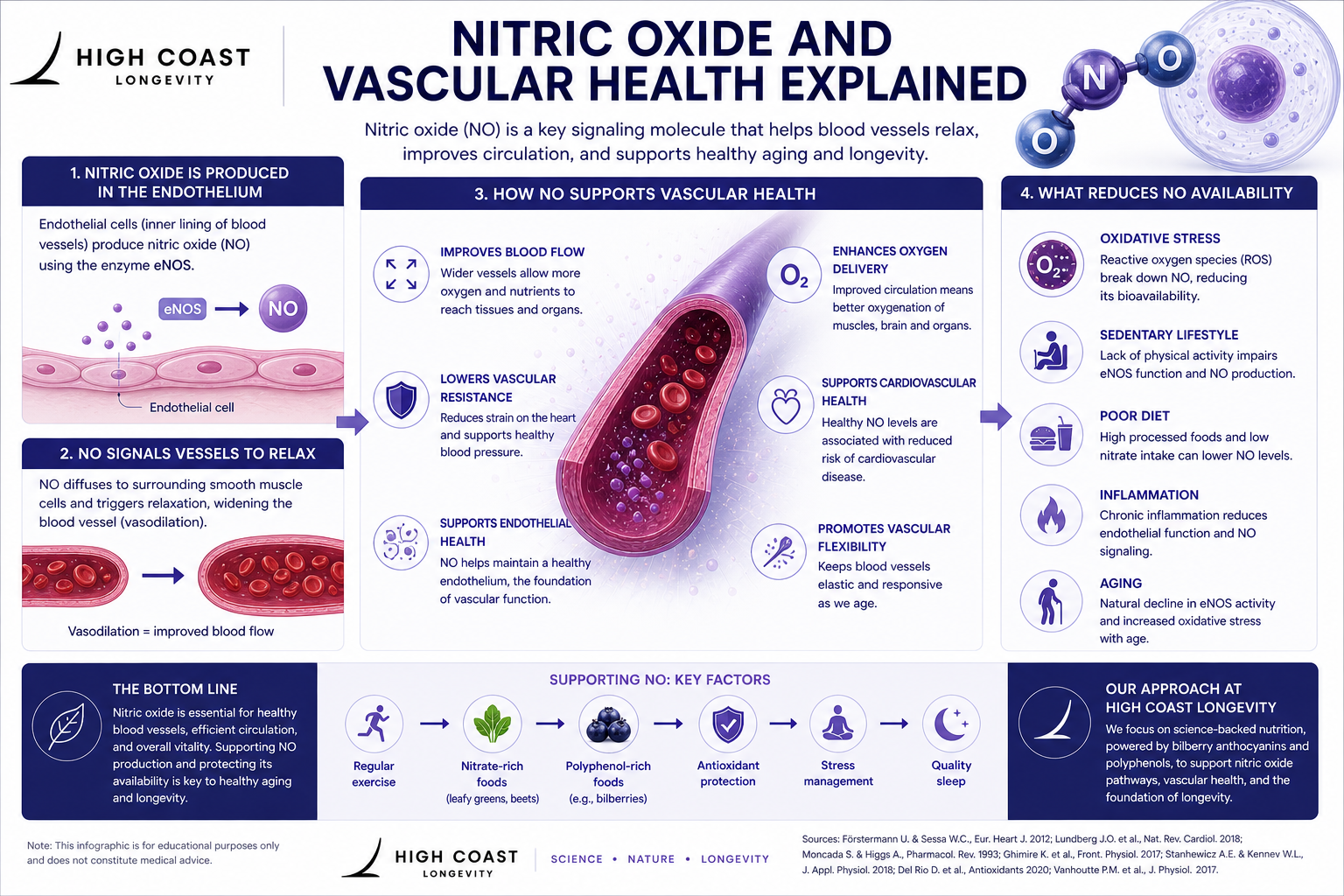
Nitric oxide is primarily produced in the endothelium (the inner lining of blood vessels) by the enzyme endothelial nitric oxide synthase (eNOS).
Healthy endothelial cells continuously generate NO to maintain vascular tone and homeostasis.
Vasodilation and Blood Flow
Once produced, nitric oxide diffuses into surrounding smooth muscle cells, causing relaxation of the vessel wall.
This process, known as vasodilation, allows:
- Increased blood flow
- Reduced vascular resistance
- Improved nutrient and oxygen delivery
Interaction with Oxidative Stress
Reactive oxygen species (ROS) can rapidly degrade nitric oxide, reducing its availability.
This creates a feedback loop:
- Increased oxidative stress → lower NO
- Lower NO → impaired circulation
- Impaired circulation → further oxidative stress
Effects of Aging
Aging is associated with:
- Reduced eNOS activity
- Increased oxidative stress
- Endothelial dysfunction
Together, these factors significantly reduce nitric oxide bioavailability, contributing to vascular aging and decreased physiological resilience.
What Reduces Nitric Oxide Availability
Several factors are associated with reduced NO levels:
- Aging
- Physical inactivity
- Poor dietary patterns
- Chronic inflammation
- Oxidative stress
- Metabolic dysfunction
These factors often interact, compounding their effects on vascular health.
What May Support Nitric Oxide Function
Evidence suggests that nitric oxide pathways can be supported through:
- Regular physical activity
- Diets rich in nitrate-containing vegetables (e.g. leafy greens)
- Polyphenol-rich foods (e.g. berries)
- Maintenance of endothelial health
- Reduction of oxidative stress
These interventions appear to act by either enhancing NO production or preserving its bioavailability.
Supporting Research
Moncada & Higgs (1993)
Identified nitric oxide as a critical signaling molecule in the cardiovascular system, establishing its foundational role in vascular regulation.
→ Pharmacological Reviews
Förstermann & Sessa (2012)
Described the central role of nitric oxide synthases and endothelial function in cardiovascular health and disease.
→ European Heart Journal
Ghimire et al. (2017)
Reviewed how oxidative stress contributes to endothelial dysfunction and reduces nitric oxide bioavailability.
→ Frontiers in Physiology
Stanhewicz & Kenney (2018)
Demonstrated that aging impairs nitric oxide–mediated vasodilation due to reduced endothelial function and increased oxidative stress.
→ Journal of Applied Physiology
Lundberg, Carlström & Weitzberg (2018)
Expanded understanding of dietary nitrate pathways and their role in nitric oxide production and vascular health.
→ Nature Reviews Cardiology
Hickok & Thomas (2019)
Explored nitric oxide signaling in physiology and disease, including its role in cellular communication and redox balance.
→ Free Radical Biology & Medicine
Del Rio et al. (2020)
Highlighted the role of oxidative stress in cardiovascular aging and its interaction with nitric oxide pathways.
→ Antioxidants
Opländer et al. (2021)
Investigated nitric oxide metabolism and its importance in maintaining vascular and metabolic health.
→ Nitric Oxide
García-Ortiz et al. (2022)
Showed associations between endothelial dysfunction, reduced nitric oxide bioavailability, and early vascular aging in human populations.
→ Journal of Clinical Medicine
Interpretation
The current body of research consistently indicates that nitric oxide is a central regulator of vascular function and plays a significant role in the aging process.
Reduced nitric oxide availability appears to be both a consequence and a driver of endothelial dysfunction, oxidative stress, and impaired circulation.
Interventions that preserve endothelial integrity and reduce oxidative stress may therefore support nitric oxide pathways, although outcomes depend on the broader metabolic context.
Connection to the High Coast Longevity Intelligence Model
Within the High Coast Longevity Intelligence framework, nitric oxide functions as a foundational regulator that interacts with multiple biological systems.
It directly influences:
- Mitochondrial efficiency through oxygen delivery
- Oxidative balance through redox interactions
- Cellular signaling and repair mechanisms
Rather than acting in isolation, nitric oxide operates as part of an interconnected system that defines overall physiological resilience.
Part of the larger longevity framework
This article is one part of our broader review of aging biology, cellular resilience, vascular health, oxidative balance, and realistic nutritional strategies.
Read: Longevity Science Today
References
- Moncada S, Higgs A. (1993). The L-arginine-nitric oxide pathway. Pharmacological Reviews.
- Förstermann U, Sessa WC. (2012). Nitric oxide synthases: regulation and function. European Heart Journal.
- Ghimire K et al. (2017). Endothelial dysfunction, oxidative stress, and cardiovascular disease. Frontiers in Physiology.
- Stanhewicz AE, Kenney WL. (2018). Role of nitric oxide in the aging vasculature. Journal of Applied Physiology.
- Lundberg JO, Carlström M, Weitzberg E. (2018). Metabolic effects of dietary nitrate. Nature Reviews Cardiology.
- Hickok JR, Thomas DD. (2019). Nitric oxide and redox signaling in health and disease. Free Radical Biology & Medicine.
- Del Rio D et al. (2020). Oxidative stress and cardiovascular disease. Antioxidants.
- Opländer C et al. (2021). Nitric oxide in health and disease. Nitric Oxide.
- García-Ortiz L et al. (2022). Endothelial dysfunction and early vascular aging. Journal of Clinical Medicine.