

Quality Manufacturing




Safe sourcing. Qualified manufacturing. Transparent quality principles.
High Coast Longevity Intelligence develops products with a clear purpose: to make Nordic bilberry-based longevity nutrition trustworthy, science-informed, and responsibly produced. For us, quality does not begin when a product is finished. It begins earlier — with how raw materials are selected, how partners are evaluated, and how food-safety principles are applied throughout manufacturing.
Our products are made with selected contract manufacturing partners. This means that production is carried out by qualified manufacturers with the appropriate systems, facilities, documentation, and food-safety procedures in place. High Coast Longevity Intelligence is responsible for choosing partners carefully, defining product specifications, and working only with manufacturers whose quality systems match the expectations we have for our brand.
This page explains how we think about quality manufacturing, sourcing, and HACCP-based food safety.
Why quality manufacturing matters
Longevity products are consumed as part of a daily health routine. That creates a responsibility to think beyond branding, formulation, and taste. A good product also needs reliable sourcing, consistent production, documented controls, and a manufacturing environment designed to reduce food-safety risks.
Our approach is built around three principles:
- Careful sourcing — we prioritize raw materials and ingredients that fit our quality, origin, and product philosophy.
- Qualified manufacturing partners — we work with contract manufacturers that can produce according to defined specifications and recognized food-safety procedures.
- Documented food-safety thinking — we value systems such as HACCP because they focus on prevention, monitoring, corrective action, and traceability.

Our role and our manufacturing partners
High Coast Longevity Intelligence does not present itself as the factory. Instead, we work with specialized contract manufacturing partners. This allows us to combine our concept, product philosophy, and ingredient standards with the practical expertise of manufacturers who are equipped for safe and consistent food production.
When selecting a manufacturing partner, we look for more than production capacity. We want partners who understand quality documentation, batch consistency, hygiene routines, raw material handling, allergen control where relevant, and the importance of traceability.
In practice, this means that we consider areas such as:
- manufacturing competence and experience with relevant product types
- food-safety systems and HACCP-based routines
- ingredient handling and supplier documentation
- batch-level traceability
- hygiene, cleaning, and contamination-prevention routines
- quality-control procedures before, during, and after production
- ability to follow our product specifications
- openness to documentation, review, and continuous improvement
Our goal is simple: the product should be produced in a way that customers can feel confident about.

What HACCP means
HACCP stands for Hazard Analysis and Critical Control Points. It is a structured food-safety approach used to identify, prevent, monitor, and control potential hazards in food production.
Instead of relying only on final product checks, HACCP focuses on the full process. It asks: where could a biological, chemical, or physical hazard occur, and what controls are needed to prevent or reduce that risk?
HACCP is especially relevant for products that involve natural raw materials, processing, packaging, storage, and distribution. It helps create a systematic way of thinking about food safety.
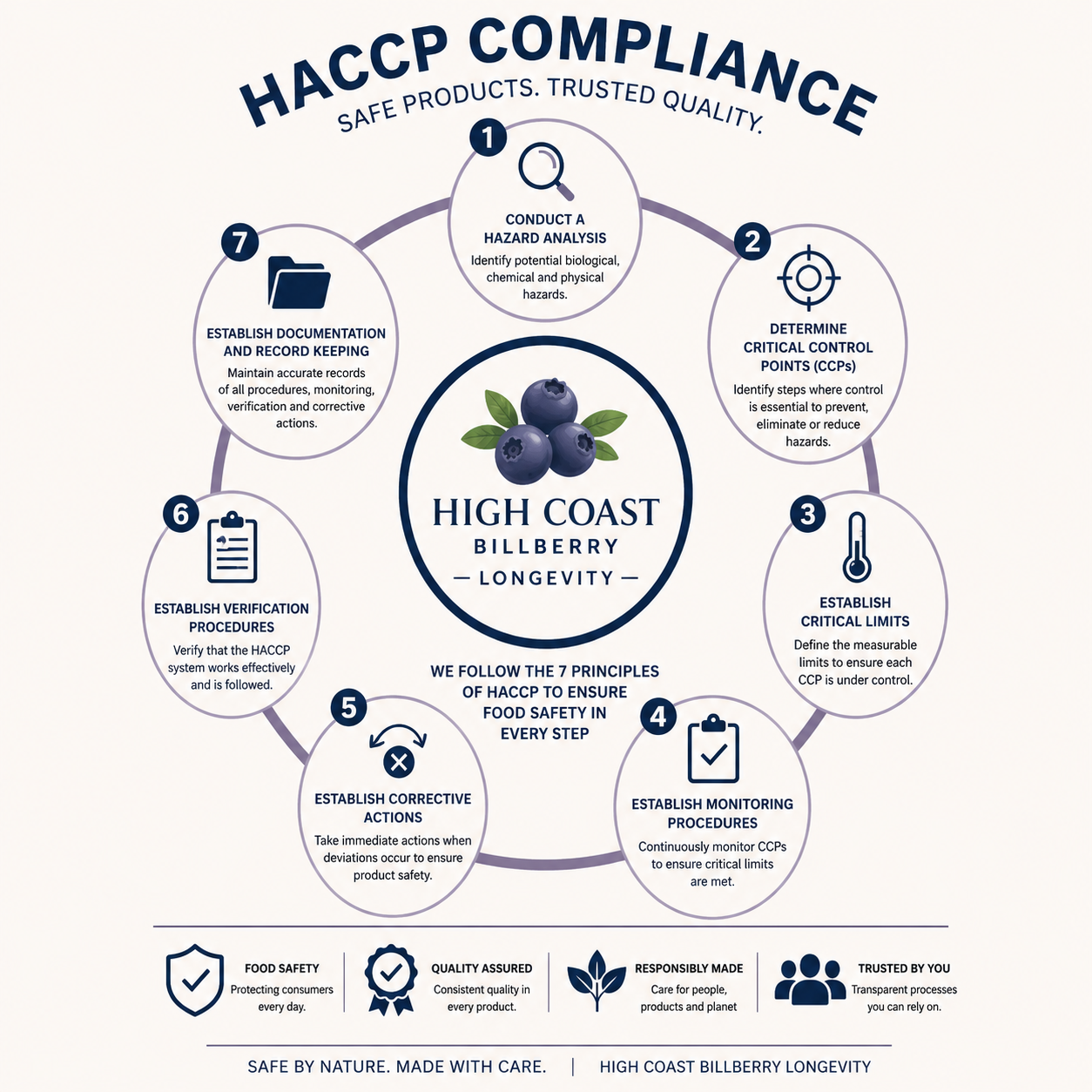
The 7 HACCP principles
The HACCP system is commonly described through seven core principles:
1. Conduct a hazard analysis
The first step is to identify potential hazards that could affect product safety. These may include biological hazards, chemical hazards, or physical contamination risks. The goal is to understand where risks could appear in the production chain.
2. Determine critical control points
A critical control point, often called a CCP, is a step where control is essential to prevent, eliminate, or reduce a food-safety hazard to an acceptable level. This may relate to processing, temperature, cleaning, ingredient handling, packaging, or other production steps depending on the product.
3. Establish critical limits
For each critical control point, measurable limits are defined. These limits help determine whether the process is under control. A critical limit could involve time, temperature, moisture, pH, visual inspection criteria, or other relevant parameters.
4. Establish monitoring procedures
Monitoring ensures that critical control points stay within the defined limits. This may involve scheduled checks, measurements, production records, or documented observations.
5. Establish corrective actions
If something falls outside the defined limits, there must be a clear plan for what happens next. Corrective actions help ensure that deviations are handled properly and that product safety is protected.
6. Establish verification procedures
Verification confirms that the HACCP system works as intended. This can include internal reviews, audits, testing, calibration checks, documentation review, or other quality-control activities.
7. Establish documentation and record keeping
Documentation is essential. A reliable food-safety system needs records showing what was checked, when it was checked, what the results were, and what actions were taken if something needed correction.

Our sourcing philosophy
High Coast Longevity Intelligence is inspired by Nordic nature, bilberries, and the idea that daily nutrition can support a long-term health strategy. This makes sourcing central to our identity.
We aim to select ingredients and suppliers based on relevance, quality, documentation, and fit with our product concept. For bilberry-based products, this includes attention to the origin, handling, and quality of berry-derived ingredients. For supporting ingredients, we look at function, safety, compatibility, and documentation.
Our sourcing philosophy is based on:
- choosing ingredients that fit the product’s purpose
- prioritizing documented quality over vague marketing claims
- working with suppliers and manufacturers that can support traceability
- avoiding unnecessary complexity where a cleaner formulation is possible
- improving specifications as the product platform develops
How we select manufacturing partners
We see manufacturing as a partnership, not only a transaction. A strong manufacturing partner should be able to help protect the product’s quality from raw material intake to finished goods.
Before working with a partner, we consider whether the manufacturer can support the level of documentation and process control required for the product. This includes food-safety routines, quality assurance, production suitability, and willingness to work according to agreed specifications.
Important criteria include:
Food-safety mindset
We prefer partners who work systematically with food safety and understand HACCP-based production principles.
Traceability
The ability to trace ingredients, batches, production dates, and relevant documentation is important for accountability and quality follow-up.
Process control
Manufacturing should be controlled, repeatable, and documented. A product should not depend on improvisation.
Ingredient handling
Natural ingredients require careful handling to protect quality. This includes storage, hygiene, and contamination-prevention routines.
Transparency and collaboration
We value partners who are open to documentation, quality dialogue, and continuous improvement.
What this means for customers
For customers, quality manufacturing means that the product is not only designed with care but also produced through a controlled process.
It means that we take food safety seriously, that we choose manufacturing partners carefully, and that we do not want to make vague claims without explaining the principles behind them.
When you see our quality manufacturing symbol, it means:
- the product is made through qualified contract manufacturing partners
- HACCP-based food-safety principles are considered important in the manufacturing process
- sourcing and documentation are part of our quality thinking
- product safety, consistency, and traceability matter to us
- we believe customers deserve transparency about how quality is approached
Our promise
High Coast Longevity Intelligence is built around trust. We are not only interested in what a product contains, but also how it is made, where its ingredients come from, and whether the production process is handled responsibly.
Our quality manufacturing approach is part of that promise.
We will continue to develop our quality standards as our product platform grows, and we will keep communicating these principles clearly so that customers can understand what stands behind the High Coast Longevity Intelligence name.