
Introduction
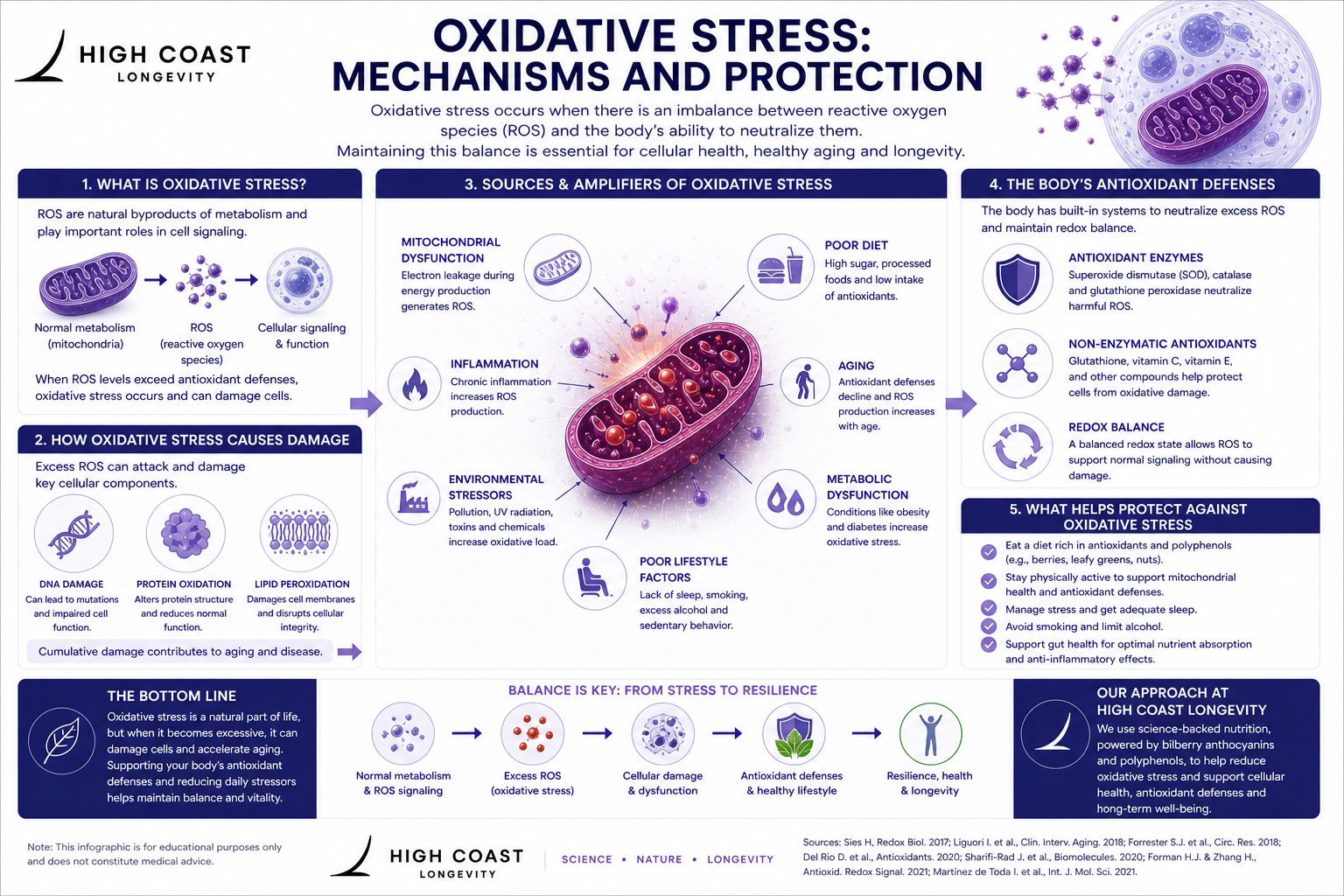
Oxidative stress is a fundamental biological process that arises when there is an imbalance between reactive oxygen species (ROS) and the body’s ability to neutralize them.
While ROS are natural byproducts of cellular metabolism and play important roles in signaling, excessive accumulation can damage cellular structures, impair function, and contribute to aging and disease.
Key Takeaways
- Oxidative stress results from an imbalance between ROS and antioxidant defenses
- Mitochondria are both a source and target of oxidative stress
- Excess oxidative stress contributes to cellular damage and aging
- Antioxidant systems regulate, rather than eliminate, ROS
- Diet and lifestyle factors influence oxidative balance
Why It Matters for Longevity
Oxidative stress is closely linked to multiple hallmarks of aging.
At the cellular level, excessive ROS can:
- Damage DNA, proteins, and lipids
- Impair mitochondrial function
- Disrupt cellular signaling
Over time, this contributes to:
- Reduced cellular efficiency
- Increased inflammation
- Accelerated biological aging
Maintaining oxidative balance is therefore not about eliminating ROS, but about preserving the dynamic equilibrium required for normal cellular function.
Biological Mechanisms
Formation of Reactive Oxygen Species
Reactive oxygen species are generated primarily during mitochondrial respiration, where electrons are transferred through the electron transport chain to produce ATP.
A small proportion of electrons leak during this process, forming ROS such as:
- Superoxide (O₂⁻)
- Hydrogen peroxide (H₂O₂)
Under normal conditions, these molecules serve signaling roles.
Oxidative Damage
When ROS levels exceed the capacity of antioxidant defenses, they can react with cellular components, leading to:
- Lipid peroxidation (damage to cell membranes)
- Protein oxidation (loss of function or misfolding)
- DNA damage (mutations and impaired replication)
This cumulative damage is a key contributor to cellular aging.
Endogenous Antioxidant Systems
The body maintains oxidative balance through internal defense systems, including:
- Superoxide dismutase (SOD)
- Catalase
- Glutathione system
These systems neutralize excess ROS and regulate redox signaling.
Interaction with Mitochondrial Function
Mitochondria are both a source and a target of oxidative stress.
Excess ROS can:
- Damage mitochondrial DNA
- Impair the electron transport chain
- Reduce ATP production
This creates a feedback loop:
- Dysfunctional mitochondria → more ROS → further dysfunction
Interaction with Nitric Oxide
Oxidative stress also directly affects nitric oxide (NO) pathways.
Reactive oxygen species can:
- Degrade nitric oxide
- Reduce vasodilation
- Impair endothelial function
This links oxidative stress to vascular aging and reduced circulation.
What Increases Oxidative Stress
Several factors are associated with elevated oxidative stress:
- Aging
- Chronic inflammation
- Poor diet
- Environmental stressors (pollution, toxins)
- Physical inactivity
- Metabolic disorders
These factors often act together, amplifying their effects.
What May Support Oxidative Balance
Maintaining oxidative balance involves supporting the body’s regulatory systems:
- Regular physical activity
- Nutrient-dense diets rich in antioxidants
- Polyphenol intake (e.g. berries, plant compounds)
- Adequate sleep and recovery
- Reduction of chronic inflammation
Importantly, antioxidant support does not aim to eliminate ROS entirely, but to maintain physiological balance.
Supporting Research
Sies (2017)
Defined oxidative stress as a disruption of redox signaling and control, emphasizing its role in cellular regulation rather than purely damage.
→ Redox Biology
Liguori et al. (2018)
Reviewed the role of oxidative stress in aging and chronic diseases, highlighting its systemic impact.
→ Clinical Interventions in Aging
Forrester et al. (2018)
Explored reactive oxygen species as signaling molecules, redefining their role beyond cellular damage.
→ Circulation Research
Del Rio et al. (2020)
Examined the relationship between oxidative stress and cardiovascular disease, including its interaction with nitric oxide pathways.
→ Antioxidants
Martínez de Toda et al. (2021)
Investigated oxidative stress as a key factor in immune aging and overall physiological decline.
→ International Journal of Molecular Sciences
Sharifi-Rad et al. (2020)
Reviewed the role of natural antioxidants and polyphenols in modulating oxidative stress and cellular health.
→ Biomolecules
Forman & Zhang (2021)
Discussed redox signaling and the importance of maintaining balance between oxidants and antioxidants.
→ Antioxidants & Redox Signaling
Interpretation
The current body of research indicates that oxidative stress is not inherently harmful, but becomes problematic when regulatory systems fail to maintain balance.
Rather than eliminating reactive oxygen species, the goal is to preserve redox homeostasis, where ROS can perform signaling functions without causing excessive damage.
Interventions that support antioxidant systems and reduce chronic stressors appear to play a role in maintaining this balance.
Connection to the High Coast Longevity Intelligence Model
Within the High Coast Longevity Intelligence framework, oxidative stress acts as a central connecting mechanism between multiple biological systems.
It directly influences:
- Mitochondrial function through damage to energy-producing systems
- Nitric oxide availability through redox interactions
- Cellular integrity through effects on DNA and proteins
This positions oxidative balance as a key regulator of overall physiological resilience and aging.
Part of the larger longevity framework
This article is one part of our broader review of aging biology, cellular resilience, vascular health, oxidative balance, and realistic nutritional strategies.
Read: Longevity Science Today
References
- Sies H. (2017). Oxidative stress: A concept in redox biology and medicine. Redox Biology.
- Liguori I et al. (2018). Oxidative stress, aging, and diseases. Clinical Interventions in Aging.
- Forrester SJ et al. (2018). Reactive oxygen species in metabolic and inflammatory signaling. Circulation Research.
- Del Rio D et al. (2020). Oxidative stress and cardiovascular disease. Antioxidants.
- Sharifi-Rad J et al. (2020). Antioxidant effects of plant polyphenols. Biomolecules.
- Martínez de Toda I et al. (2021). Oxidative stress and immune aging. International Journal of Molecular Sciences.
- Forman HJ, Zhang H. (2021). Targeting oxidative stress in disease. Antioxidants & Redox Signaling.