

Introduction
Polyphenols are a diverse group of bioactive compounds found in plant-based foods, including berries, fruits, vegetables, and tea.
They have attracted significant scientific interest due to their potential role in modulating oxidative stress, inflammation, and cellular signaling—processes closely linked to aging and longevity.
Key Takeaways
- Polyphenols are plant-derived compounds with biological activity
- They influence cellular signaling rather than acting as simple antioxidants
- Polyphenols may support mitochondrial function and vascular health
- Their effects are context-dependent and influenced by metabolism
- Diets rich in polyphenols are associated with improved health outcomes
Why It Matters for Longevity
Aging is driven in part by dysregulation of cellular processes such as oxidative balance, inflammation, and metabolism.
Polyphenols may influence these processes by interacting with signaling pathways that regulate:
- Energy metabolism
- Cellular defense systems
- Gene expression
Rather than acting as isolated agents, polyphenols function within the broader context of diet and lifestyle.
Biological Mechanisms
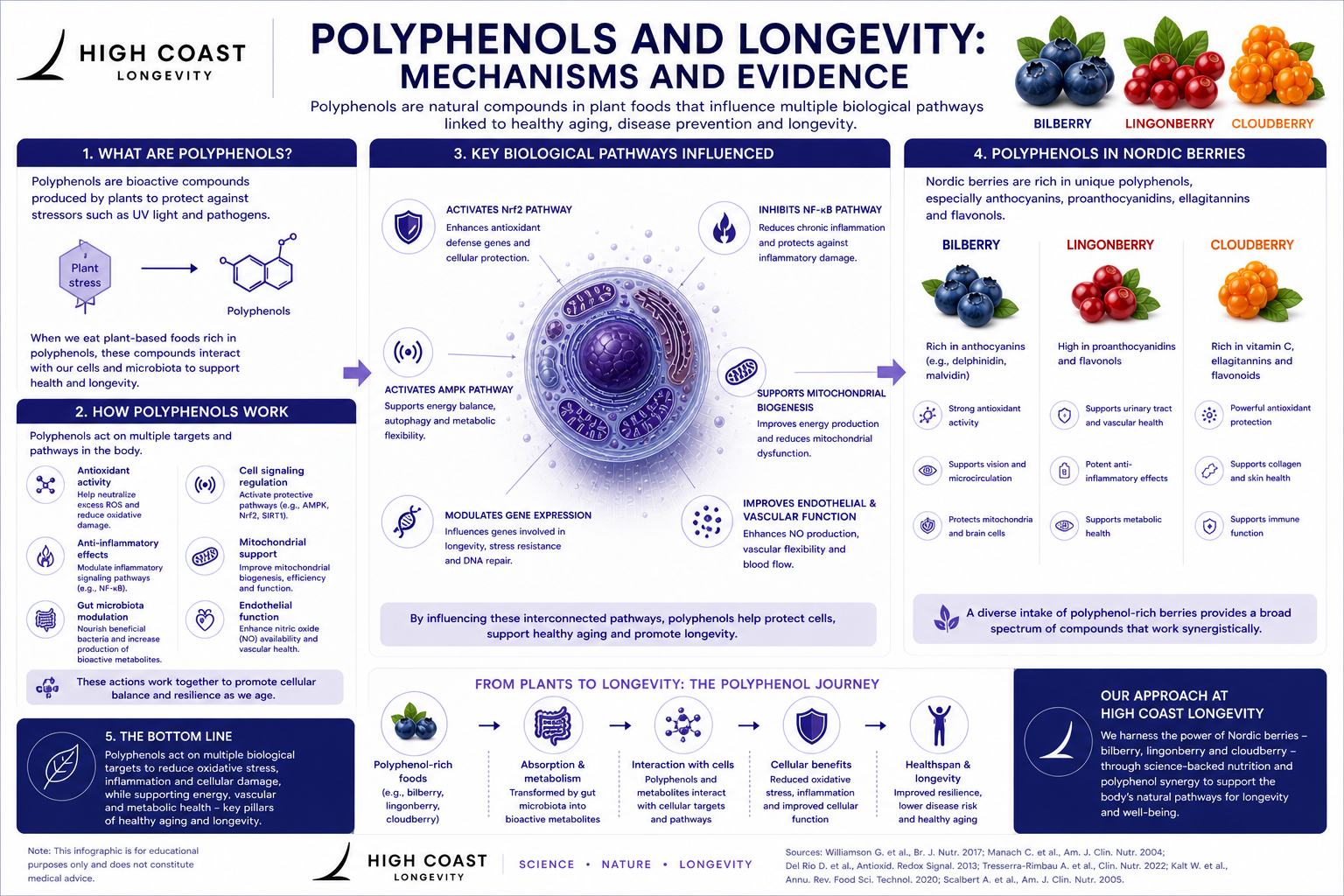
Redox Modulation
Polyphenols can influence oxidative balance by:
- Interacting with reactive oxygen species
- Supporting endogenous antioxidant systems
Importantly, they regulate rather than eliminate oxidative processes.
Cellular Signaling Pathways
Polyphenols affect key pathways involved in cellular function, including:
- AMPK (energy regulation)
- Nrf2 (antioxidant response)
- NF-κB (inflammation regulation)
These pathways are central to maintaining cellular homeostasis.
Mitochondrial Function
Some polyphenols have been shown to:
- Support mitochondrial efficiency
- Influence mitochondrial biogenesis
- Improve metabolic flexibility
These effects are linked to energy production and cellular resilience.
Vascular and Nitric Oxide Effects
Polyphenols may also influence endothelial function and nitric oxide pathways, contributing to:
- Improved blood flow
- Enhanced vascular health
What Influences Polyphenol Effects
The biological impact of polyphenols depends on:
- Bioavailability
- Gut microbiota interactions
- Dosage and dietary context
- Individual metabolic state
This variability explains differences in outcomes across studies.
What May Support Polyphenol Activity
- Diverse, plant-rich diets
- Whole food consumption (rather than isolated compounds)
- Healthy gut microbiome
- Balanced metabolic function
Supporting Research
Scalbert et al. (2005)
Provided an early overview of polyphenols and their biological effects in humans.
→ American Journal of Clinical Nutrition
Manach et al. (2004)
Reviewed bioavailability and metabolism of polyphenols.
→ American Journal of Clinical Nutrition
Williamson (2017)
Discussed the role of polyphenols in human health beyond antioxidant activity.
→ British Journal of Nutrition
Del Rio et al. (2013)
Explored dietary polyphenols and their health implications.
→ Antioxidants & Redox Signaling
Godos et al. (2019)
Linked polyphenol intake with reduced risk of chronic diseases.
→ Nutrients
Kalt et al. (2020)
Reviewed health effects of anthocyanin-rich foods.
→ Annual Review of Food Science
Tresserra-Rimbau et al. (2022)
Showed associations between polyphenol intake and improved metabolic markers.
→ Clinical Nutrition
Interpretation
The evidence suggests that polyphenols contribute to health not through a single mechanism, but through coordinated effects on cellular systems.
Their role appears to be regulatory, influencing pathways that maintain balance within the body.
This supports the view that polyphenols are most effective as part of a broader dietary and lifestyle context.
Connection to the High Coast Longevity Intelligence Model
Within the High Coast Longevity Intelligence framework, polyphenols function as modulators of key biological systems.
They intersect with:
- Mitochondrial function
- Oxidative balance
- Nitric oxide pathways
- Cellular signaling
This positions them as supportive components within an integrated longevity strategy.
Part of the larger longevity framework
This article is one part of our broader review of aging biology, cellular resilience, vascular health, oxidative balance, and realistic nutritional strategies.
Read: Longevity Science Today
References
- Scalbert A et al. (2005). Dietary polyphenols and health. AJCN.
- Manach C et al. (2004). Polyphenol bioavailability. AJCN.
- Williamson G. (2017). Role of polyphenols in health. Br J Nutr.
- Del Rio D et al. (2013). Polyphenols and health. Antioxidants & Redox Signaling.
- Godos J et al. (2019). Polyphenols and disease risk. Nutrients.
- Kalt W et al. (2020). Anthocyanins and health. Annual Review Food Sci.
- Tresserra-Rimbau A et al. (2022). Polyphenols and metabolic health. Clinical Nutrition.