

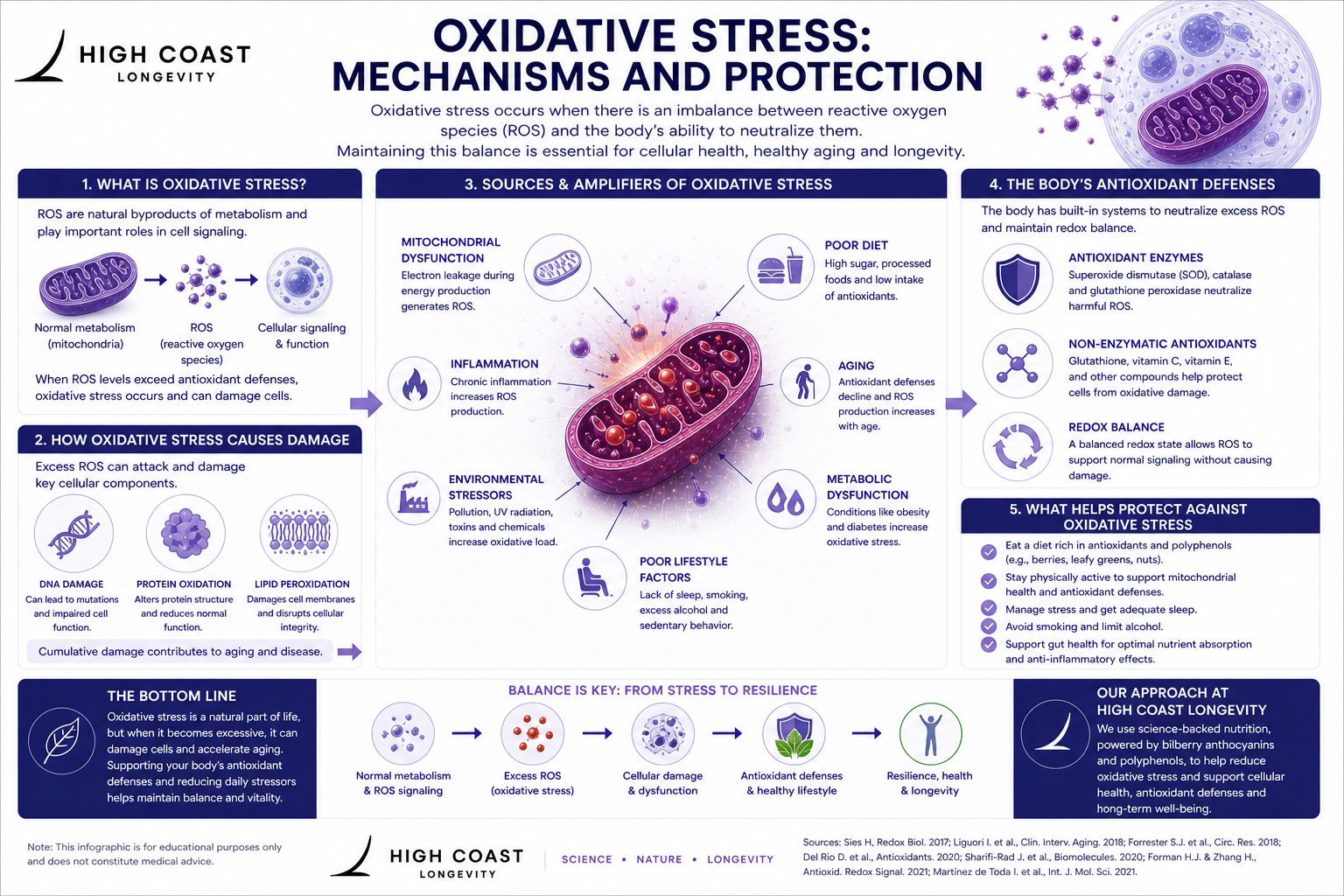
Oxidative stress refers to an imbalance between reactive oxygen species and the body’s antioxidant and redox-regulating systems. It is closely connected to mitochondrial function, inflammation, endothelial health, nitric oxide availability, immune function, and age-related tissue decline. In longevity science, oxidative stress is important because it can act both as a damaging force and as part of normal cellular signaling.
This curated list brings together key research on oxidative stress, redox biology, reactive oxygen species, aging, chronic disease, inflammation, and cardiovascular health. These papers help explain why oxidative balance is not simply about “removing free radicals,” but about maintaining the right biological conditions for cellular communication, repair, and resilience.
These papers support one part of the broader High Coast Longevity Intelligence framework described in Longevity Science Today.
Oxidative Stress
Oxidative stress: a concept in redox biology and medicine
Authors: Helmut Sies
Publication: Redox Biology, 2015
Type: Review
Tags: oxidative stress, redox biology, antioxidant defense, cellular signaling, molecular damage
This paper defines oxidative stress as a disturbance in redox signaling and control, often accompanied by molecular damage. It is a foundational reference for understanding oxidative stress as more than simple “free radical damage.” The paper explains why redox balance, antioxidant enzymes, cellular signaling, and biological context are central to understanding oxidative stress in health and disease.
Oxidative stress, aging, and diseases
Authors: Ilaria Liguori, Gennaro Russo, Francesco Curcio, Giulia Bulli, Luisa Aran, David Della-Morte, Gaetano Gargiulo, Gianluca Testa, Francesco Cacciatore, Domenico Bonaduce, Pasquale Abete
Publication: Clinical Interventions in Aging, 2018
Type: Review
Tags: oxidative stress, aging, chronic disease, inflammation, antioxidant defenses
This review describes how oxidative stress contributes to aging and age-related diseases through the accumulation of reactive oxygen and nitrogen species, reduced antioxidant defenses, inflammation, and cellular damage. It connects oxidative imbalance with cardiovascular disease, neurodegeneration, frailty, and other chronic conditions associated with aging.
Reactive Oxygen Species in Metabolic and Inflammatory Signaling
Authors: Steven J. Forrester, Daisuke S. Kikuchi, Marina S. Hernandes, Qingbo Xu, Kathy K. Griendling
Publication: Circulation Research, 2018
Type: Review
Tags: reactive oxygen species, ROS, metabolic signaling, inflammation, redox biology, disease mechanisms
This review explains how reactive oxygen species function not only as damaging molecules, but also as important signaling mediators in metabolism and inflammation. It discusses how ROS are produced in specific cellular compartments and how altered redox signaling can contribute to metabolic dysfunction, inflammatory disease, and long-term tissue stress.
Oxidative Stress in Cardiovascular Diseases
Authors: Manon Dubois-Deruy, Vladimir Peugnet, Alain Turkieh, Florence Pinet
Publication: Antioxidants, 2020
Type: Review
Tags: oxidative stress, cardiovascular disease, mitochondria, endothelial dysfunction, nitric oxide, ROS
This review examines the role of oxidative stress in cardiovascular disease, including its effects on endothelial function, mitochondrial activity, vascular remodeling, and nitric oxide availability. It explains how excess reactive oxygen species can reduce NO bioavailability, impair vascular relaxation, and contribute to hypertension, atherosclerosis, heart failure, and other cardiovascular conditions.