
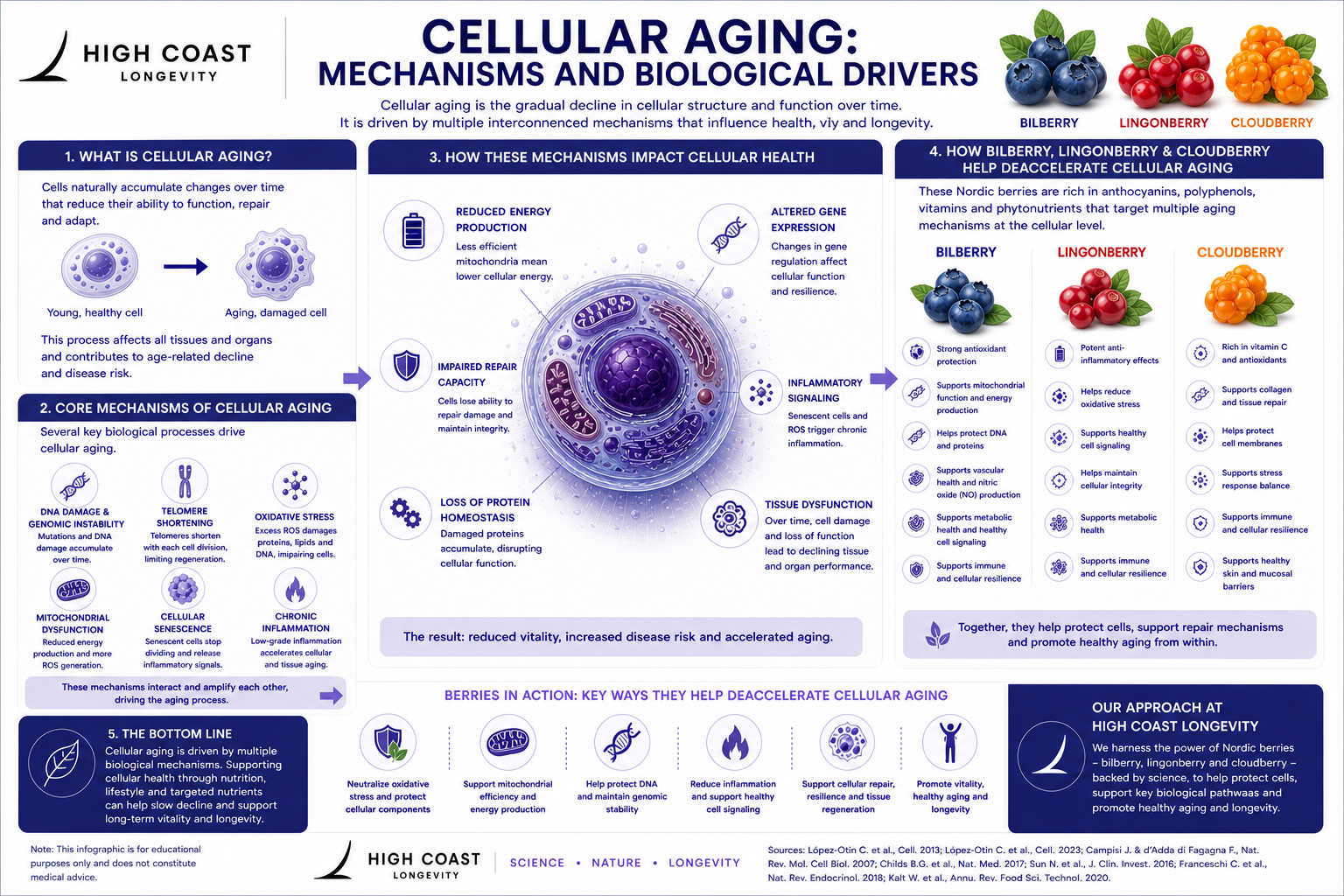
Cellular aging describes the gradual decline in cellular function that occurs as damage, stress, and regulatory changes accumulate over time. It includes processes such as genomic instability, telomere attrition, mitochondrial dysfunction, cellular senescence, inflammation, and altered communication between cells. These mechanisms help explain why tissues lose resilience with age and why aging affects many biological systems at once.
This curated list brings together foundational and updated research on the biological mechanisms of aging, with a particular focus on the hallmarks of aging and cellular senescence. These papers provide a framework for understanding aging as a measurable biological process shaped by interconnected cellular and molecular drivers.
These papers support one part of the broader High Coast Longevity Intelligence framework described in Longevity Science Today.
Cellular Aging
The Hallmarks of Aging
Authors: Carlos López-Otín, Maria A. Blasco, Linda Partridge, Manuel Serrano, Guido Kroemer
Publication: Cell, 2013
Type: Review
Tags: hallmarks of aging, cellular aging, genomic instability, telomeres, mitochondria, senescence
This landmark review defined nine major hallmarks of aging, including genomic instability, telomere attrition, epigenetic alterations, loss of proteostasis, deregulated nutrient sensing, mitochondrial dysfunction, cellular senescence, stem cell exhaustion, and altered intercellular communication. It remains one of the most influential frameworks for understanding aging as a biological process.
Hallmarks of aging: An expanding universe
Authors: Carlos López-Otín, Maria A. Blasco, Linda Partridge, Manuel Serrano, Guido Kroemer
Publication: Cell, 2023
Type: Review
Tags: hallmarks of aging, biological aging, systems biology, cellular resilience, longevity science
This updated review expands the original hallmarks of aging framework and places aging within a broader systems-level model. It emphasizes that aging mechanisms are interconnected and that biological decline involves multiple layers of regulation, including cellular stress responses, inflammation, altered communication, and loss of homeostasis.
Cellular senescence: when bad things happen to good cells
Authors: Judith Campisi, Fabrizio d’Adda di Fagagna
Publication: Nature Reviews Molecular Cell Biology, 2007
Type: Review
Tags: cellular senescence, DNA damage, aging, cancer, stress response
This review explains cellular senescence as a stress response in which damaged or at-risk cells permanently stop dividing. It describes how senescence can protect against cancer, but also how the accumulation of senescent cells and their inflammatory signaling may contribute to tissue dysfunction and aging.
Cellular senescence in aging and age-related disease: from mechanisms to therapy
Authors: Bennett G. Childs, Matej Durik, Darren J. Baker, Jan M. van Deursen
Publication: Nature Medicine, 2015
Type: Review
Tags: cellular senescence, aging, inflammation, tissue dysfunction, senolytics
This review describes how senescent cells contribute to aging and age-related disease through permanent growth arrest, altered tissue signaling, and secretion of inflammatory factors. It also discusses emerging therapeutic strategies aimed at targeting senescent cells or modifying their effects in age-related conditions.