
Science
Science is among the most respected scientific journals in the world and regularly publishes important research in aging biology, cellular function, genetics, and longevity science. For visitors interested in understanding the mechanisms behind healthy aging, Science offers valuable insight into how cells age, how organisms differ in lifespan, and how future scientific approaches may influence age-related decline.
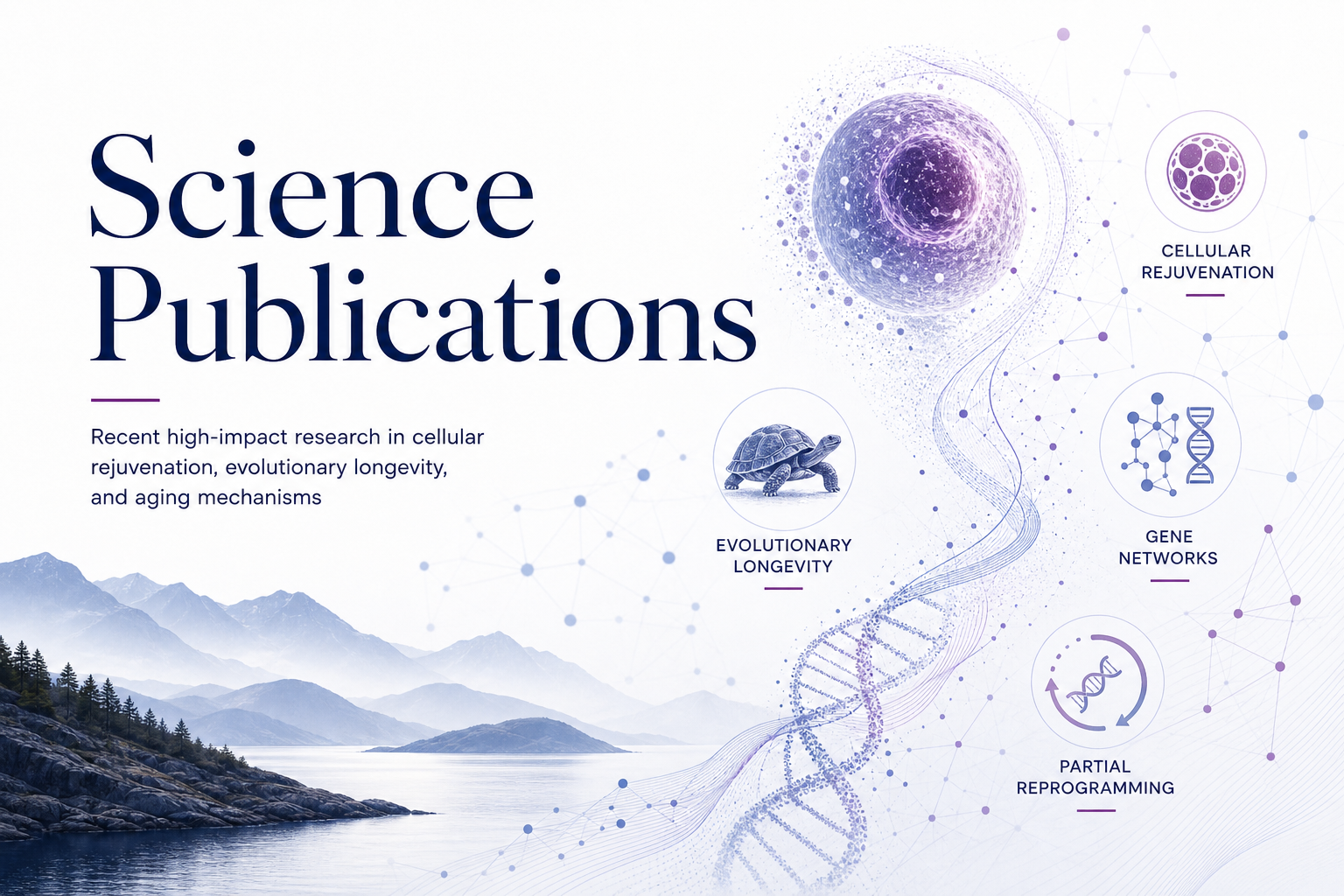
This curated list highlights recent Science publications connected to the High Coast Longevity Intelligence framework, including cellular aging, evolutionary longevity, gene networks, and partial cellular reprogramming. The goal is to make high-impact research easier to explore and to connect scientific discovery with the biological systems that shape long-term health, resilience, and longevity.
For a broader interpretation of how these publications fit into modern longevity science, read Longevity Science Today.
Recent Publications
Engineering longevity—design of a synthetic gene oscillator to slow cellular aging
Authors: Zhen Zhou, Yuting Liu, Yushen Feng, Stephen Klepin, Lev S. Tsimring, Lorraine Pillus, Jeff Hasty, Nan Hao
Publication: Science, 2023
This study used synthetic biology to engineer a genetic oscillator that slowed cellular aging in yeast. By influencing how cells transition between different aging states, the researchers extended cellular lifespan. The paper is important because it shows that aging-related cellular dynamics can be experimentally modified through gene network design.
Slow and negligible senescence among testudines challenges evolutionary theories of senescence
Authors: Rita da Silva, Dalia A. Conde, Annette Baudisch, Fernando Colchero
Publication: Science, 2022
This comparative study examined aging patterns in turtles and tortoises and found that many species show slow or negligible senescence. The results challenge the idea that aging progresses similarly across all vertebrates and provide important insight into evolutionary longevity biology. The paper is relevant for understanding why some species maintain function and survival far longer than others.
Targeted partial reprogramming of age-associated cell states improves markers of health in mouse models of aging
Authors: Kumar Sahu et al.
Publication: Science Translational Medicine, 2024
This preclinical study investigated targeted partial reprogramming of aged, stressed, and senescent cells in mouse models. The approach aimed to improve age-associated cellular states while reducing risks linked to broad reprogramming. The paper is important in the context of cellular rejuvenation research, but it should be understood as early-stage experimental science rather than a proven human intervention.