
Frontier Longevity Technologies
Some longevity technologies are scientifically emerging, while others remain speculative. A serious platform must distinguish between the two.
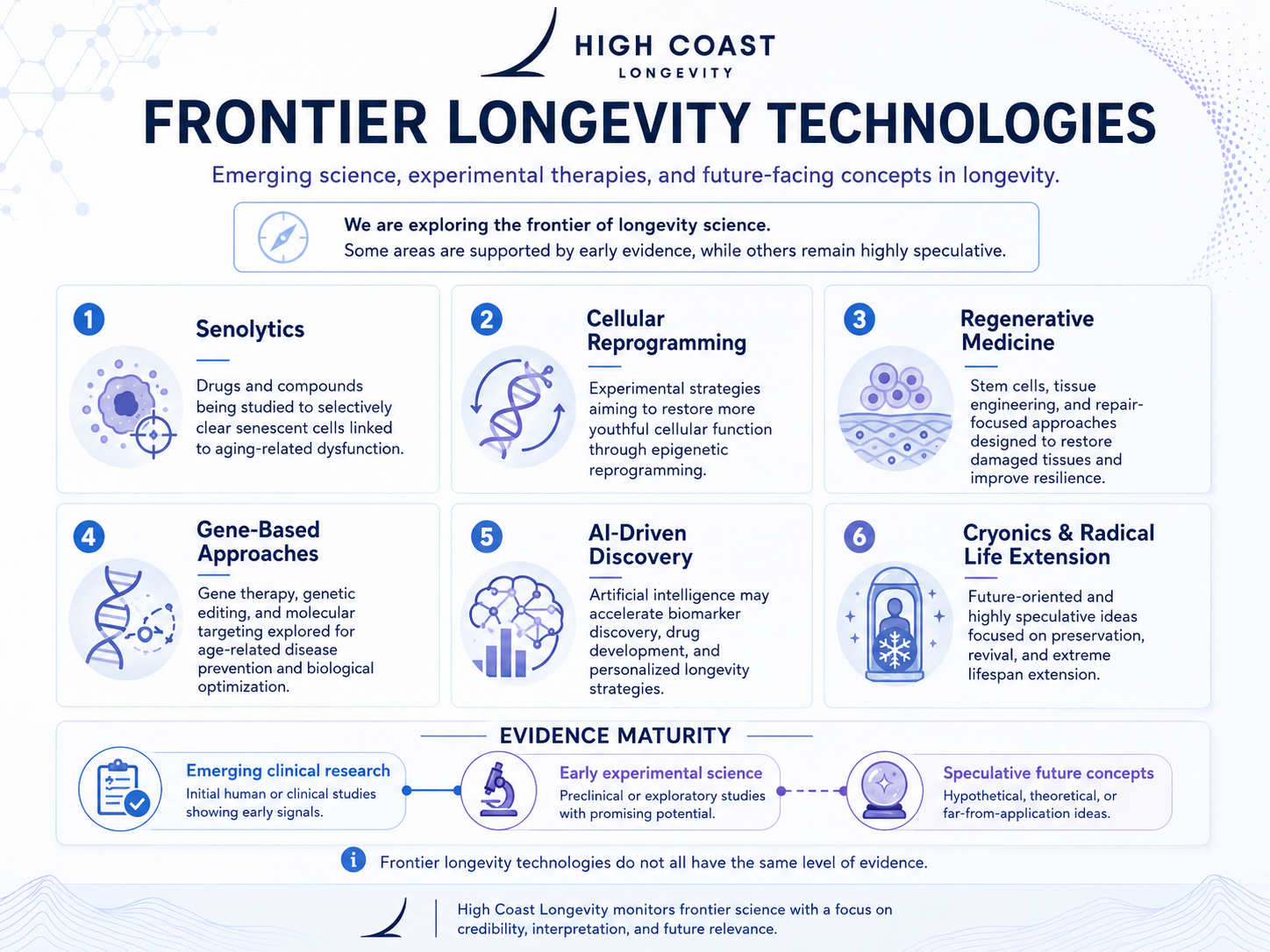
Longevity science includes established diagnostics, emerging medical research, experimental therapies, and speculative future concepts. Some areas, such as senolytics, regenerative medicine, and cellular reprogramming, are actively studied in scientific and clinical settings. Others, such as cryonics and radical life extension concepts, remain highly uncertain.
High Coast Longevity Intelligence monitors this landscape because it is part of the broader future of longevity. However, monitoring a field does not mean endorsing every idea or presenting it as ready for use.
The purpose is to understand what is scientifically credible, what is still experimental, and what remains speculative.
Why monitor frontier science?
Longevity is a fast-moving field.
Important developments may emerge from:
• geroscience
• regenerative medicine
• cellular biology
• gene-based medicine
• AI-supported drug discovery
• tissue engineering
• advanced diagnostics
• cryobiology
A serious platform should follow these areas without confusing early research with proven practice.
Emerging geroscience
Geroscience studies the biological mechanisms that connect aging with disease.
This area may include:
• cellular senescence
• senolytics
• inflammation control
• nutrient sensing
• mitochondrial pathways
• epigenetic regulation
• biological age biomarkers
Some approaches may become clinically relevant in the future, but most are still developing.
Cellular reprogramming
Partial cellular reprogramming is one of the most discussed frontier areas in aging science.
It explores whether aged cells can regain more youthful functional patterns without losing identity or safety.
This area remains experimental and requires careful discussion because it is scientifically exciting but not yet a consumer-ready longevity intervention.
Regenerative medicine
Regenerative medicine aims to repair or replace damaged tissues.
This may include:
• stem cell research
• tissue engineering
• organ regeneration
• exosome-related research
• repair-focused therapies
Some uses are already part of medicine, while others remain early-stage or experimental.
Cryonics and radical life extension
Cryonics and radical life extension concepts attract attention because they address the most extreme questions in longevity.
These ideas may include:
• preservation technologies
• future revival concepts
• radical lifespan extension
• speculative future medicine
They should be described as speculative unless supported by strong evidence. They belong in the category of frontier longevity, not established healthcare.
Evidence maturity
Not all technologies are equally mature.
High Coast Longevity Intelligence evaluates frontier technologies by asking:
• Is there credible science?
• Is there human evidence?
• Is it safe?
• Is it measurable?
• Can it guide action today?
• Is it ready for clinical use?
• Is it still speculative?
This distinction protects both scientific credibility and public trust.
Responsible communication
Frontier science should be communicated clearly.
Avoiding exaggeration is important because longevity is vulnerable to hype.
A responsible platform should separate:
• established diagnostics
• emerging clinical research
• early-stage experimental science
• speculative future concepts
This makes it possible to stay future-facing without becoming unrealistic.
Current stage
Frontier longevity technologies are not presented as current High Coast Longevity Intelligence services.
This page describes a monitoring and evaluation area within the broader platform. Technologies may be followed, discussed, or integrated in the future only when evidence, safety, interpretation, and partner standards support their relevance.
Build the future through selected partnerships
Frontier technologies require careful evaluation, clinical responsibility, and specialist environments. A partner network can help connect relevant diagnostics, research, and future services in a structured way.