
Cell Press
Cell and the wider Cell Press family are leading scientific publications in molecular biology, cellular biology, genetics, systems biology, and biomedical research. Within longevity science, Cell Press papers often provide important frameworks for understanding aging at the level of cells, pathways, biomarkers, and biological systems.
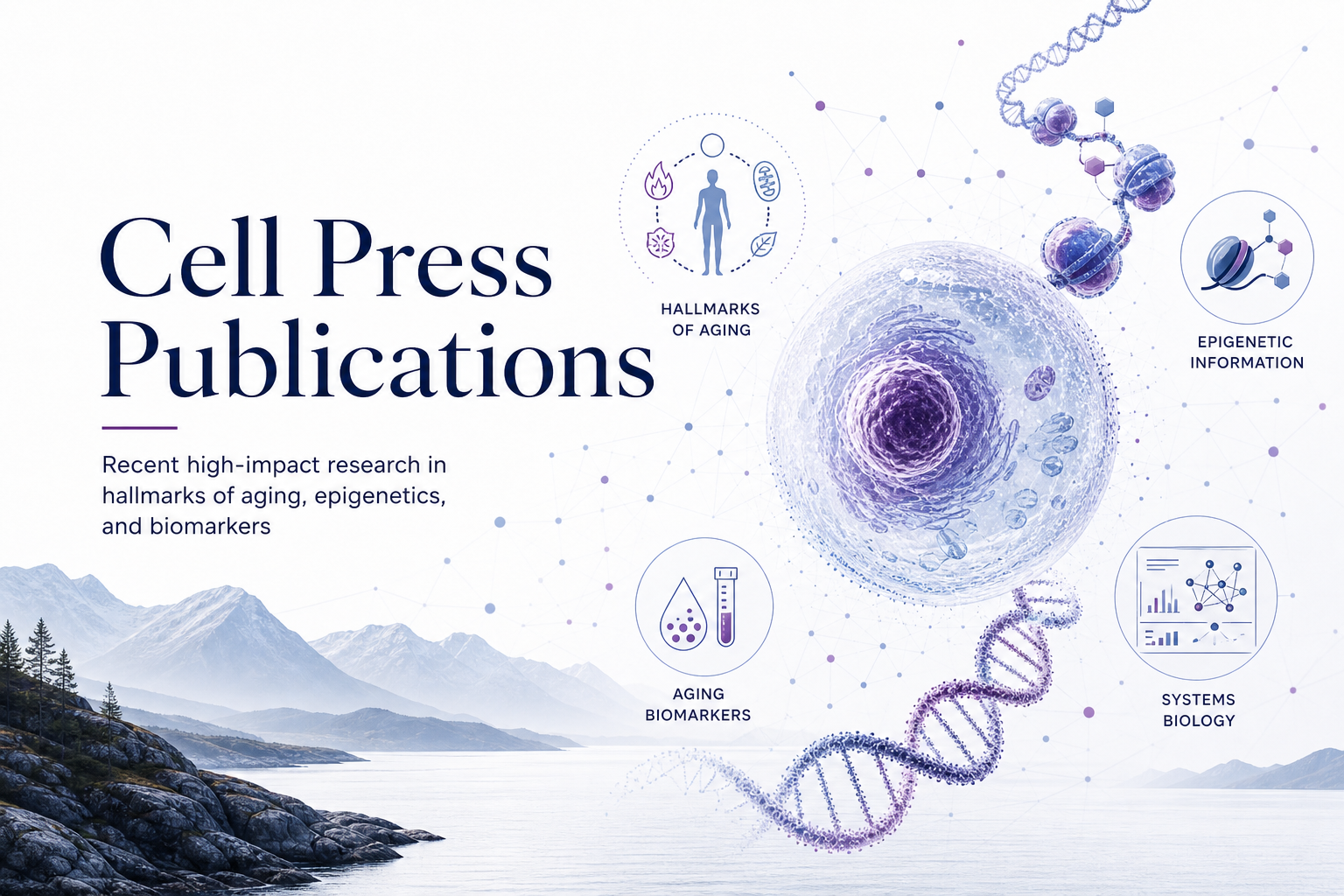
This curated list highlights recent Cell Press publications connected to the High Coast Longevity Intelligence framework, including the hallmarks of aging, epigenetic information, aging biomarkers, and systems-level mechanisms of biological decline. The goal is to help visitors understand how modern aging research explains longevity through measurable biological processes rather than vague anti-aging claims.
For a broader interpretation of how these publications fit into modern longevity science, read Longevity Science Today.
Curated recent publications
Hallmarks of aging: An expanding universe
Authors: Carlos López-Otín, Maria A. Blasco, Linda Partridge, Manuel Serrano, Guido Kroemer
Publication: Cell, 2023
This paper updates one of the most influential frameworks in aging biology. It describes aging as a systems-level process involving multiple interconnected mechanisms, including genomic instability, telomere attrition, epigenetic alterations, mitochondrial dysfunction, cellular senescence, inflammation, and altered nutrient sensing. It is a central reference for understanding modern longevity science.
Loss of epigenetic information as a cause of mammalian aging
Authors: Jae-Hyun Yang et al.
Publication: Cell, 2023
This study investigates whether loss of epigenetic information can drive mammalian aging. Using an experimental system that induces DNA breaks and alters epigenetic organization, the paper explores how disruption of cellular information systems may contribute to age-related decline. It is relevant to biological age, epigenetic aging, and cellular repair mechanisms.
Biomarkers of aging for the identification and evaluation of longevity interventions
Authors: Biomarkers of Aging Consortium
Publication: Cell, 2023
This paper proposes a framework for defining, classifying, and validating biomarkers of aging. It highlights the need for reliable biological markers that can be used to evaluate longevity interventions in research and clinical settings. The paper is important because it supports a measurable, evidence-based approach to longevity rather than relying on vague anti-aging claims.