

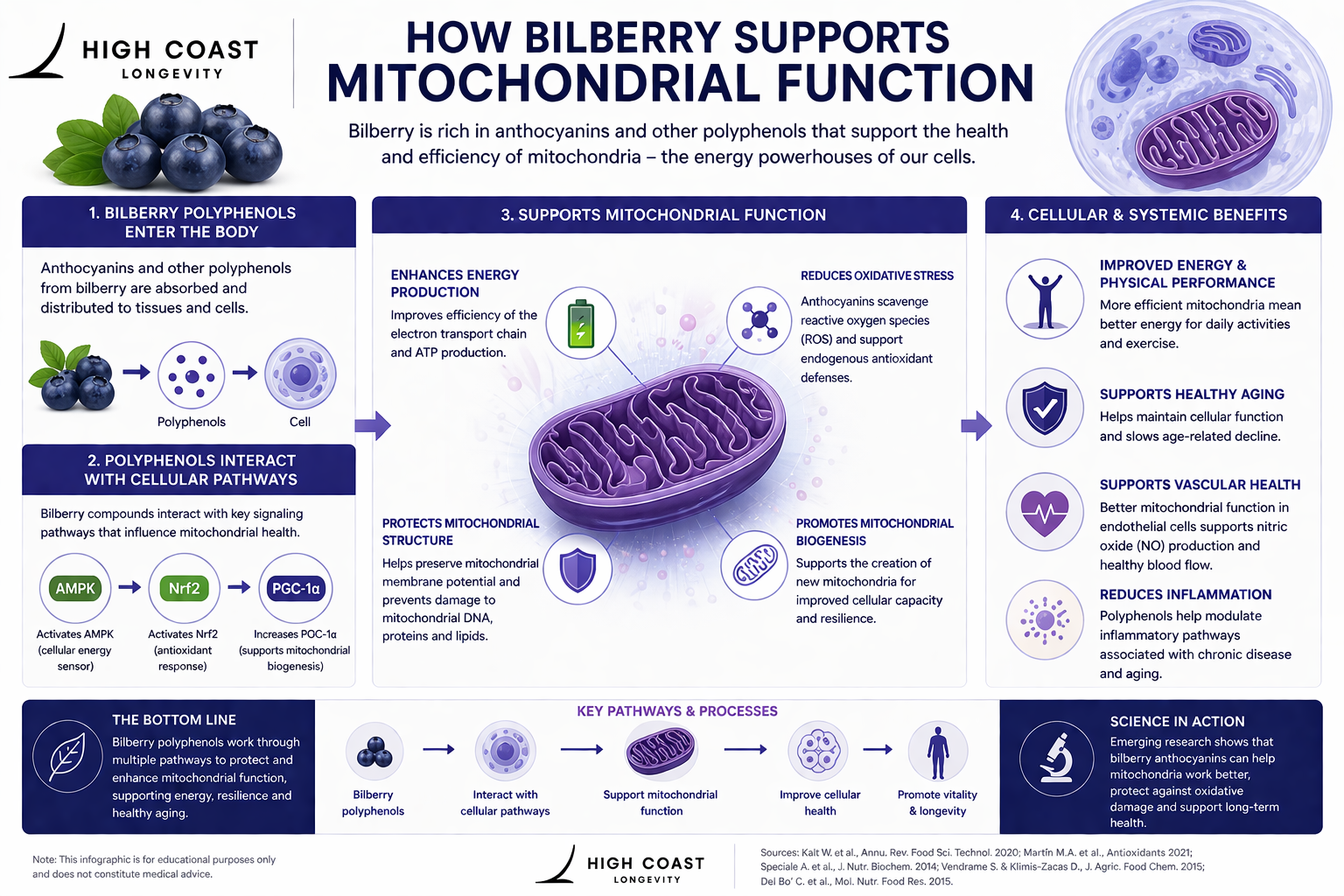
Mitochondria are central to cellular energy production, metabolic regulation, stress responses, and biological resilience. As cells age, mitochondrial quality and efficiency can decline, contributing to reduced ATP production, increased oxidative stress, impaired cellular repair, inflammation, and age-related loss of function.
This curated list brings together key research on mitochondrial dysfunction, mitochondrial DNA, oxidative stress, mitochondrial biogenesis, AMPK signaling, and energy regulation. These papers help explain why mitochondrial health is a core theme in longevity science and why cellular energy systems are closely connected to aging, resilience, and long-term physiological performance.
These papers support one part of the broader High Coast Longevity Intelligence framework described in Longevity Science Today.
Mitochondrial Function
The Mitochondrial Basis of Aging
Authors: Nuo Sun, Richard J. Youle, Toren Finkel
Publication: Molecular Cell, 2016
Type: Review
Tags: mitochondria, aging, energy metabolism, mitophagy, cellular senescence, inflammation
This review explains how declining mitochondrial quality and activity are associated with normal aging and age-related disease. It discusses how mitochondria contribute to cellular senescence, chronic inflammation, stem cell decline, mitophagy, mitochondrial stress responses, and longevity-related signaling pathways.
The role of mitochondria in aging
Authors: Ana Bratic, Nils-Göran Larsson
Publication: Journal of Clinical Investigation, 2013
Type: Review
Tags: mitochondria, oxidative stress, mitochondrial DNA, ROS, respiratory chain, aging
This review examines the role of mitochondria in aging, including mitochondrial DNA mutations, respiratory chain dysfunction, reactive oxygen species, and the mitochondrial free radical theory of aging. It also discusses newer perspectives on mitochondrial signaling and how mitochondrial changes may influence age-related decline.
Metabolic control of mitochondrial biogenesis through the PGC-1 family regulatory network
Authors: Richard C. Scarpulla
Publication: Biochimica et Biophysica Acta (BBA) - Molecular Cell Research, 2011
Type: Review
Tags: mitochondrial biogenesis, PGC-1, energy metabolism, transcriptional regulation, cellular adaptation
This review describes how mitochondrial biogenesis is regulated through the PGC-1 family of transcriptional coactivators. It explains how cells coordinate mitochondrial formation, oxidative metabolism, energy demand, and stress adaptation through transcriptional networks that control mitochondrial function.
AMPK: An Energy-Sensing Pathway with Multiple Inputs and Outputs
Authors: D. Grahame Hardie, Bethany E. Schaffer, Anne Brunet
Publication: Trends in Cell Biology, 2016
Type: Review
Tags: AMPK, energy sensing, metabolism, mitochondrial regulation, cellular stress, longevity pathways
This review explains AMPK as a central energy-sensing pathway that responds to changes in cellular energy status. When activated, AMPK helps restore energy balance by increasing ATP-generating processes and reducing energy-consuming pathways. It is important for understanding how cells regulate metabolism, mitochondrial activity, stress responses, and adaptation under energetic pressure.