
New England Journal of Medicine
The New England Journal of Medicine is one of the world’s most respected clinical medical journals, publishing influential research and reviews across medicine, aging, chronic disease, and human health. In the context of longevity, NEJM publications are valuable because they connect biological aging mechanisms with clinical outcomes such as frailty, cognition, telomere biology, and age-related disease.
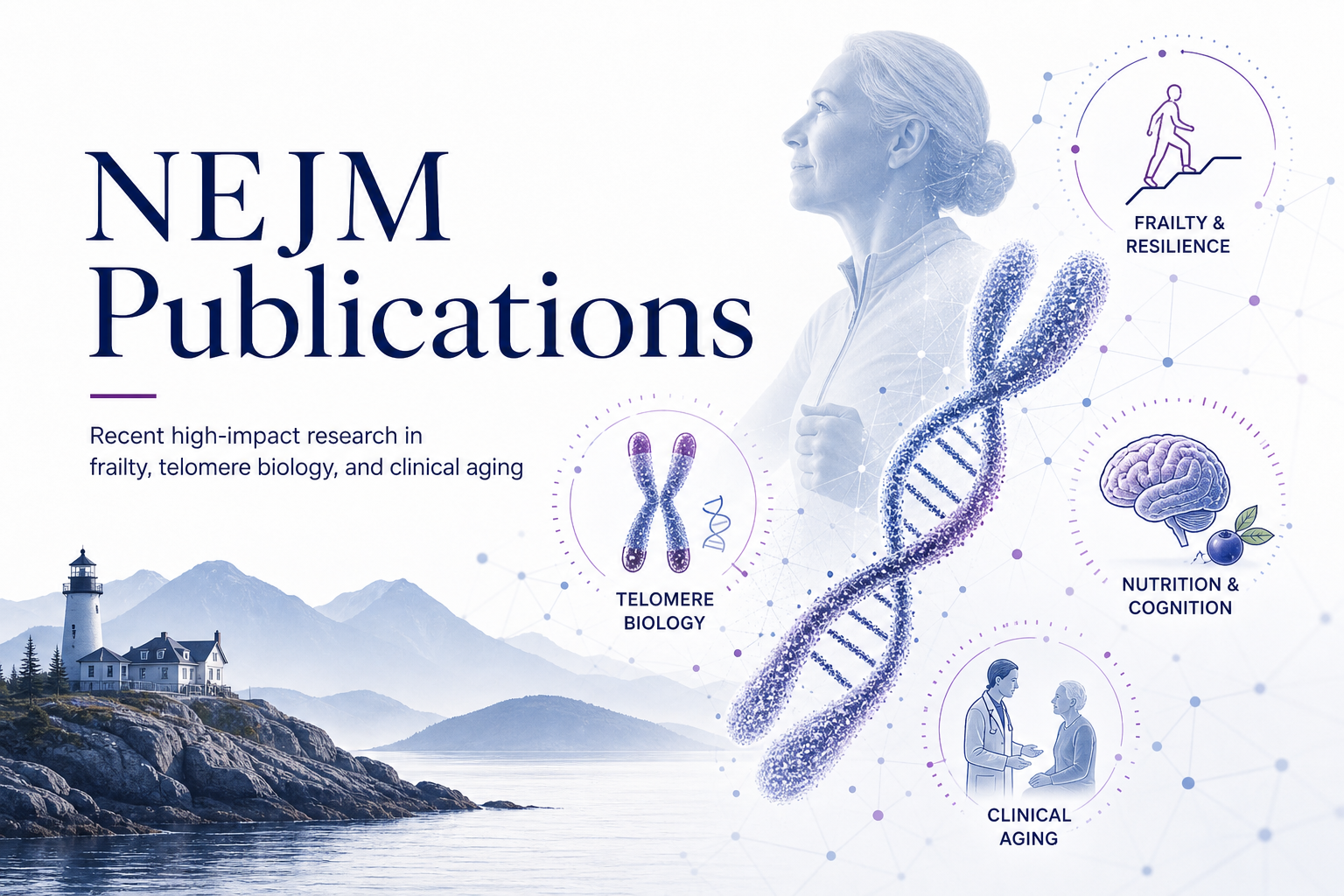
This curated list highlights recent NEJM publications connected to the High Coast Longevity Intelligence framework, including frailty, physiological resilience, telomere biology, nutrition, and cognitive aging. The goal is to bring clinically relevant research into the broader longevity discussion and show how aging biology appears in real-world health outcomes.
For a broader interpretation of how these publications fit into modern longevity science, read Longevity Science Today.
Curated recent publications
Frailty in Older Adults
Authors: Dae Hyun Kim, Kenneth Rockwood
Publication: New England Journal of Medicine, 2024
This clinical review explains frailty as a state of reduced physiological reserve and increased vulnerability in older adults. It covers assessment, biological contributors, and clinical management of frailty. The paper is relevant to longevity because frailty represents a practical clinical expression of declining resilience across multiple body systems.
Familial Clonal Hematopoiesis in a Long Telomere Syndrome
Authors: Emily DeBoy et al.
Publication: New England Journal of Medicine, 2023
This study investigates long telomere biology in families with POT1-related genetic variants and links long telomeres with clonal hematopoiesis and cancer risk. The paper is important because it shows that telomere biology is complex and should not be reduced to the simple idea that “longer telomeres are always better.”
Trial of the MIND Diet for Prevention of Cognitive Decline in Older Persons
Authors: Lisa L. Barnes, Klodian Dhana, Xiaoran Liu, Vincent J. Carey, Jennifer Ventrelle, Kathleen Johnson, Chiquia Hollings, Nancy Laranjo, Benjamin J. Stubbs, Xavier Reilly, Puja Agarwal, Shengwei Zhang, Francine Grodstein, Christy C. Tangney, Thomas M. Holland, Neelum T. Aggarwal, Konstantinos Arfanakis, Martha Clare Morris, Frank M. Sacks
Publication: New England Journal of Medicine, 2023
This randomized clinical trial tested whether the MIND diet could help prevent cognitive decline in older adults. The study is relevant to nutrition and brain aging because it evaluates a dietary pattern in a controlled human trial. It also shows why longevity nutrition should be discussed carefully: dietary patterns may be biologically plausible, but clinical outcomes need rigorous testing.