

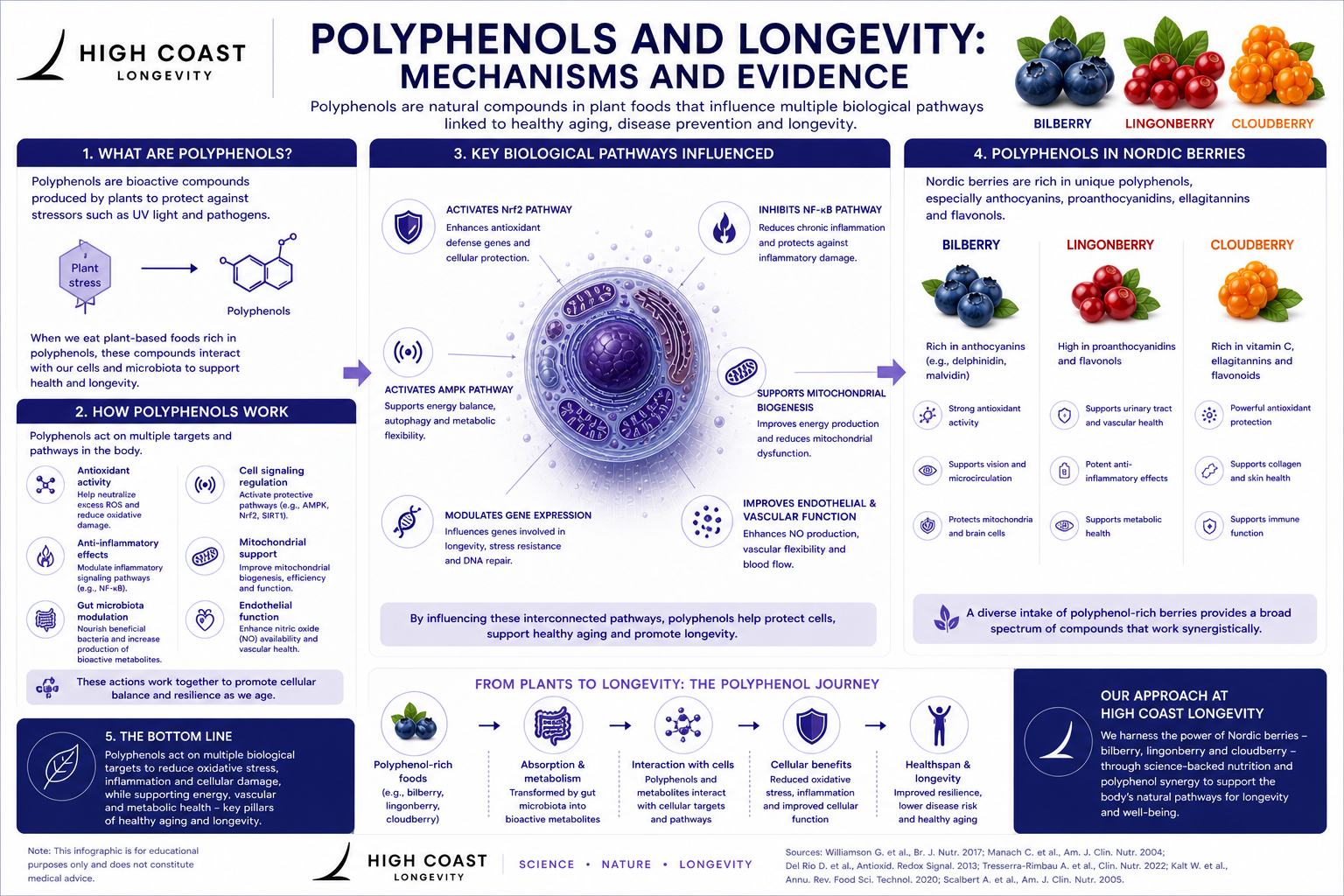
Polyphenols are bioactive compounds found in plant-based foods such as berries, fruits, vegetables, cocoa, tea, and other botanical sources. In longevity science, they are relevant because they interact with biological systems involved in oxidative balance, inflammation, vascular function, metabolism, mitochondrial health, and cellular signaling.
This curated list brings together foundational and modern research on polyphenols, bioavailability, anthocyanins, berries, and metabolic health. These papers help explain why the health effects of polyphenol-rich foods depend not only on antioxidant capacity, but also on absorption, metabolism, gut interactions, signaling pathways, and long-term dietary patterns.
These papers support one part of the broader High Coast Longevity Intelligence framework described in Longevity Science Today.
Polyphenols & Berries
Polyphenols: antioxidants and beyond
Authors: Augustin Scalbert, Ian T. Johnson, Mike Saltmarsh
Publication: The American Journal of Clinical Nutrition, 2005
Type: Review
Tags: polyphenols, antioxidants, diet, chronic disease, human health
This review explains how research on polyphenols has moved beyond the simple idea of direct antioxidant activity. It discusses the potential role of dietary polyphenols in chronic disease prevention, especially cardiovascular disease and cancer, while also emphasizing that mechanisms in humans are more complex than in vitro antioxidant effects alone.
Polyphenols: food sources and bioavailability
Authors: Claudine Manach, Augustin Scalbert, Christine Morand, Christian Rémésy, Liliana Jiménez
Publication: The American Journal of Clinical Nutrition, 2004
Type: Review
Tags: polyphenols, food sources, bioavailability, metabolism, diet
This review describes where polyphenols are found in the human diet and how their structure, food matrix, digestion, absorption, metabolism, and excretion influence their biological effects. The paper is important because it shows that the potential health effects of polyphenols depend not only on intake, but also on how well different compounds are absorbed and transformed in the body.
The role of polyphenols in modern nutrition
Authors: Gary Williamson
Publication: Nutrition Bulletin, 2017
Type: Review
Tags: polyphenols, nutrition, nitric oxide, cardiometabolic health, signaling
This review discusses the role of polyphenols in modern nutrition and highlights that their mechanisms are not fully explained by simple antioxidant activity. It describes evidence linking polyphenol-rich foods with cardiometabolic health and discusses possible biological targets including nitric oxide metabolism, carbohydrate digestion, oxidative enzymes, and cellular signaling.
Recent research on the health benefits of blueberries and their anthocyanins
Authors: Wilhelmina Kalt, Aedin Cassidy, Luke R. Howard, Robert Krikorian, April J. Stull, François Tremblay, Raul Zamora-Ros
Publication: Advances in Nutrition, 2020
Type: Review
Tags: blueberries, anthocyanins, berries, metabolism, oxidative balance, vascular health
This review summarizes research on blueberries and anthocyanins, including human observational studies, clinical trials, animal studies, and mechanistic research. It discusses potential effects on cardiovascular health, type 2 diabetes risk, weight maintenance, neuroprotection, and oxidative balance, while also noting that more human clinical evidence is needed.
Dietary polyphenol intake is associated with HDL-cholesterol and a better profile of other components of the metabolic syndrome: a PREDIMED-Plus sub-study
Authors: Anna Tresserra-Rimbau et al.
Publication: Nutrients, 2020
Type: Cross-sectional human study
Tags: polyphenols, metabolic health, HDL cholesterol, metabolic syndrome, cardiometabolic risk
This study examined dietary polyphenol intake in participants with metabolic syndrome from the PREDIMED-Plus cohort. Higher polyphenol intake was associated with a more favorable cardiometabolic profile, including HDL cholesterol and other metabolic syndrome components. The paper is useful for connecting polyphenol-rich dietary patterns with measurable metabolic health markers.